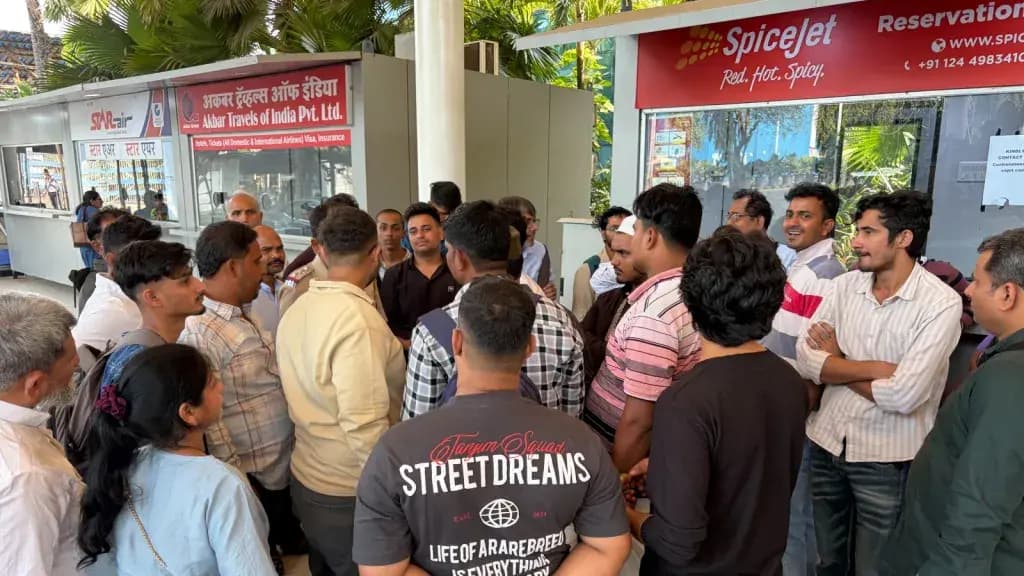

For more than three decades, Guidance Tamil Nadu has helped politicians announce investments, bureaucrats negotiate with multinational corporations, and professionals build careers in attracting industry. Over the last few weeks, however, its role has come under increased scrutiny as the agency confronts allegations that some of its former professionals helped attract investments to Andhra Pradesh.
The departure of 16 employees this year, including three who subsequently joined the Andhra Pradesh Economic Development Board (APEDB), has escalated into accusations of industrial espionage, political disloyalty and the passing of confidential information to a competing state. Guidance has denied reports of mass resignations, and so far there is no established evidence that confidential information was leaked or investments diverted.
But the controversy has exposed the problem with blurring the lines between an institution, its political masters and the professionals hired to serve it.
Guidance was established in July 1992 as the Tamil Nadu Industrial Guidance and Export Promotion Bureau during J Jayalalithaa’s first government. Its purpose was simple: to give investors a single point of contact instead of requiring them to navigate several departments independently.
Under successive administrations led by M Karunanidhi, Jayalalithaa, Edappadi K Palaniswami and M K Stalin, it developed into a professional agency, with IAS officers providing administrative leadership and consultants handling investor outreach, negotiations and project coordination.
Consultants could initiate conversations, identify opportunities and help companies navigate approvals. But investment decisions passed through senior bureaucrats, the Industries Department and, where necessary, the Cabinet.
That distinction matters because Tamil Nadu’s industrial strength rests on something considerably larger than the relationships cultivated by individual consultants. According to the state’s Economic Survey 2025–26, Tamil Nadu accounted for 15.4 per cent of India’s registered factories in 2023–24, compared with Gujarat’s 12.8 per cent, Maharashtra’s 10.2 per cent and Andhra Pradesh’s 6.2 per cent.
The state had 1,735 factories employing at least 1,000 people each, against 742 in Maharashtra and 679 in Gujarat. It also had 311 factories employing 5,000 or more workers, accounting for 35 per cent of India’s total, compared with Gujarat’s 66.
Tamil Nadu accounted for 15.2 per cent of factory employment and ranked third in manufacturing gross value added. Manufacturing contributed 24.5 per cent of the state’s gross value added in 2024–25, against the national average of 17.2 per cent. These figures reflect decades of industrial development, with ports, highways, suppliers, engineering institutions and skilled workers supporting one another.
From resignations to espionage claims
The controversy emerged after the TVK government assumed office in May. According to people familiar with the departures, 15 Guidance employees left in 2025 and 16 in 2026. Five of this year’s departures had already resigned or were serving notice before the change of government. Eleven left between May and July, including at least three who cited personal circumstances.
A senior source in the TVK government told The Indian Express that at least two consultants were asked to resign within weeks of the new administration taking office. “It is true that one of them was asked to quit immediately,” the source said. The other case, the source said, created considerable anxiety within the government. A consultant was suspected of suggesting to a foreign company, after TVK assumed power, that it consider investing in Andhra Pradesh instead. “This had panicked the new government, forcing them to travel to an East Asian country to ensure that there was no impact due to this,” the source said.
Three former Guidance professionals subsequently joined Andhra Pradesh’s investment promotion apparatus and participated in activities including the CII Partnership Summit in Visakhapatnam, where investment commitments approaching Rs 10 lakh crore were announced. Their employment with a competing state agency became central to suggestions that commercially sensitive information had travelled across state borders.
On Friday, Guidance rejected reports of mass resignations in July, describing departures as normal organisational attrition arising from career opportunities, higher education, relocation and family circumstances. It also emphasised constructive competition between states.
However, an examination of the circumstances surrounding more than a dozen departures suggests a combination of political mistrust, administrative restructuring, workplace tensions and ordinary professional mobility. According to people familiar with the transition, the new TVK administration was uneasy about the proximity of certain senior consultants to the previous DMK leadership. The change of government also brought changes in Guidance’s leadership.
Sources familiar with Guidance’s functioning said that of the 16 employees who left in 2026, five had already resigned or were serving notice before the TVK government assumed office, while at least three of the subsequent departures involved personal circumstances, including family relocation. Two senior professionals were asked to leave abruptly at the end of June. One senior consultant, who had a close association with the previous government, secured a better-paid position with a Taiwanese multinational.
The transition also generated complaints within the organisation. An outgoing employee wrote to the Chief Minister’s Office and senior officials at the end of July, alleging a hostile working environment, threats and preferential treatment under the new management. Multiple sources aware of the incident spoke of fear and anxiety over the loyalty of professionals that made the leadership hostile.
“Unlike the DMK and AIADMK, TVK entered government without an earlier administrative record, making inherited relationships within sensitive agencies a source not only of suspicion but also of fear,” said a top government source aware of the development.
Political backlash
The dispute has drawn criticism from both principal Opposition parties. AIADMK general secretary Edappadi K Palaniswami pointed out that several professionals had been recruited under his administration and accused the TVK government of undermining an institution established during Jayalalithaa’s tenure.
Former industries minister T R B Rajaa argued that the DMK had retained professionals appointed by the AIADMK because institutional experience mattered. Former finance minister P T R Palanivel Thiaga Rajan questioned how contractual employees without final decision-making authority could determine the investment fortunes of an entire state when proposals passed through multiple administrative and political levels.
A former industries secretary explained what investors actually consider before committing to a state. “Companies negotiating major investments routinely compare several states and countries. They examine land prices, power availability, logistics, fiscal incentives, suppliers, skilled labour and the reliability of government approvals. Investment professionals can influence negotiations and may possess commercially sensitive information. But companies themselves frequently disclose competing incentive packages while seeking better offers. Knowledge of those proposals does not, by itself, establish espionage,” the ex-secretary said.
A principal secretary in the Tamil Nadu government told The Indian Express that the larger concern, for Tamil Nadu, may be uncertainty during a political transition. “Investors usually wait when there is a regime change. Multinational companies making commitments that will mature over decades want assurances that approvals, land allotments and incentives negotiated under one government will survive the next,” he said, adding that the challenge was particularly important for TVK, which was governing the state for the first time.
The principal secretary also pointed to Andhra Pradesh’s emphasis on policy continuity. On November 12, Chief Minister N Chandrababu Naidu announced plans for an Investment Protection Act intended to safeguard government commitments involving land, incentives and approvals against future political changes. The state has also proposed an escrow mechanism to support timely payment of industrial incentives.
“The legislation has not been enacted, and its effectiveness remains untested. But the proposal addresses a familiar concern among investors: that an electoral change can also change the terms of a long-term investment. Andhra Pradesh’s announced investments remain commitments, not operational factories. Tamil Nadu’s established manufacturing base cannot be replicated merely by offering incentives or recruiting experienced professionals. What can be affected more quickly is confidence in the institutions responsible for negotiating and implementing those commitments. That is the larger significance of the Guidance controversy,” he said.
The former industries secretary added, “A politician or a party can seek another mandate and rebuild credibility through another campaign. An institution cannot. Its credibility is harder to recover – and, in the business of attracting factories, considerably more expensive to lose.”
Source:- indianexpress.com